Servigistics Agentic AI: Why Service Supply Chain Optimization Matters
What Is Servigistics Agentic AI?
PTC Servigistics is a service supply chain optimization solution focused on planning service parts availability across complex networks. Its capabilities include forecasting, inventory optimization and service parts planning.
Agentic AI refers to AI-based systems that can interpret objectives, coordinate tasks and use connected tools to support a workflow. Within service supply chain planning, this means an agent may help users frame a question, retrieve relevant context, invoke appropriate planning capabilities and communicate the results.
It does not mean that a large language model independently replaces the mathematical models used for forecasting and inventory optimization. The agent and the optimization engine have complementary responsibilities.
Why Is Service Supply Chain Planning Different?
 Uncertain Demand
Manufacturing material planning is often linked to production schedules. Service parts demand can be intermittent, geographically dispersed and difficult to predict. A rarely requested component may still be essential for restoring a critical asset to operation.
Multi-Level Inventory Networks
Parts may be distributed among central warehouses, regional distribution centers, dealers, service facilities and technician locations. Stocking decisions at one level affect availability elsewhere in the network.
Repair and Return Loops
Some service parts move through repair, refurbishment and return processes rather than simple purchase-and-consume flows. Planning must account for repair lead times, usable inventory and alternative sources.
Service and Inventory Tradeoffs
Increasing stock may improve parts availability but requires more working capital. Excessive reductions may lead to shortages and longer equipment downtime. The challenge is to evaluate both outcomes together.
5 Foundations for Effective Agentic AI in Service Planning
1. An Accurate Service Network Model
Planning tools need to represent the structure of the service network, supply relationships, repair loops and operational constraints. Without an accurate representation, recommendations may fail to reflect real business conditions.
2. Demand Forecasting and Uncertainty Modeling
Current inventory data explains what is available now. Forecasting models help estimate future demand and uncertainty across parts, locations and planning periods.
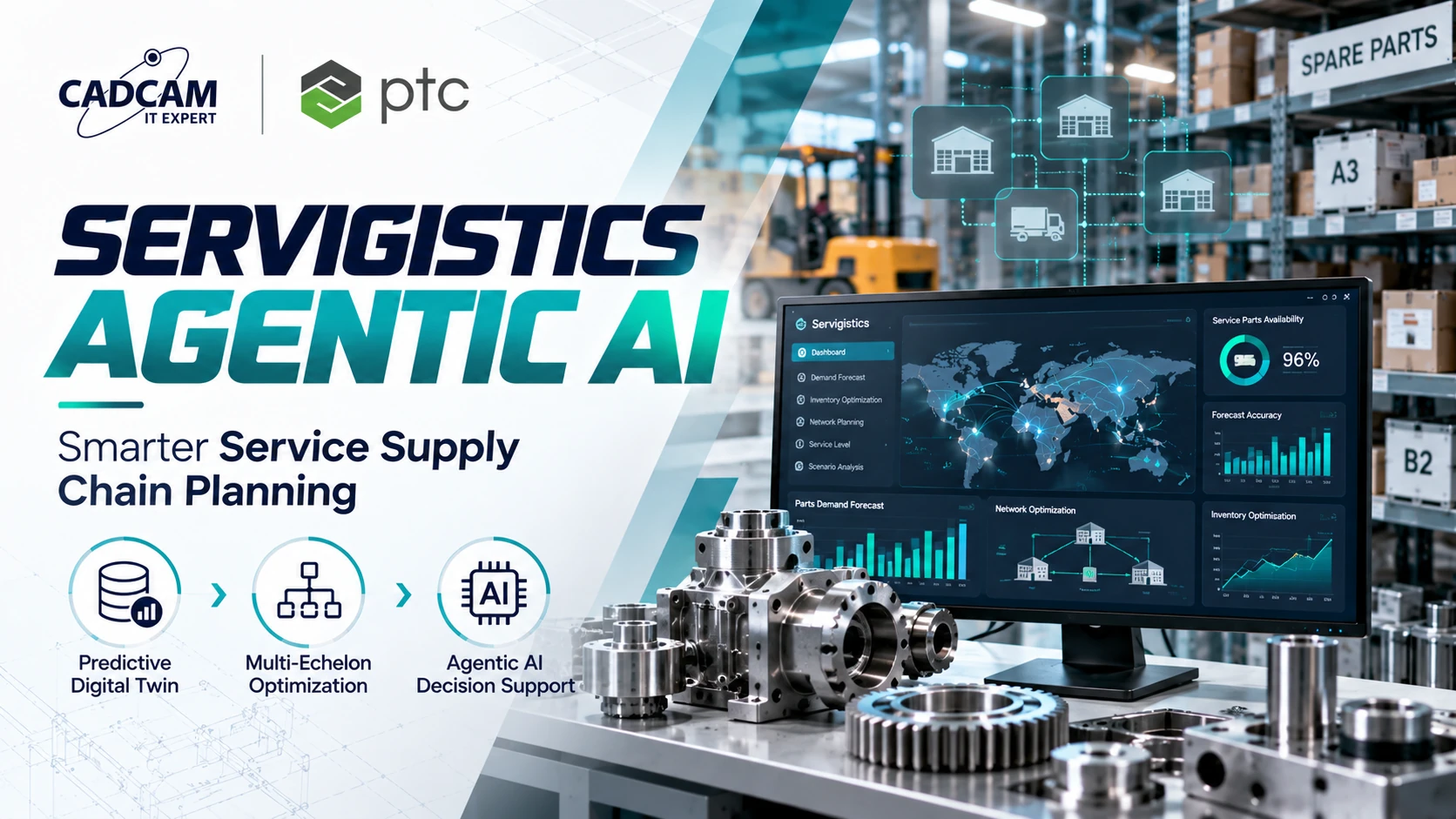
3. A Predictive Digital Twin
A predictive digital twin supports scenario analysis by representing how a service network may perform under changing conditions. Planners can compare alternatives before committing inventory or changing service policies.
4. Multi-Echelon Inventory Optimization
Multi-echelon optimization (MEO) evaluates inventory decisions across connected locations rather than treating every stocking point independently. It helps assess where inventory can support service objectives while balancing investment and risk.
5. AI Agents Connected to Decision Tools
An agent can translate a business request into a planning workflow, call appropriate forecasting and optimization tools and explain the resulting analysis. Purpose-built decision science remains responsible for evaluating quantitative tradeoffs.
Agentic AI vs Traditional Conversational AI
| Capability | Conversational AI | Agentic AI with Optimization Tools |
|---|---|---|
| Natural-Language Interaction | Yes | Yes |
| Information Summarization | Yes | Yes |
| Workflow Coordination | Depends on integrations | Core architectural objective |
| Quantitative Inventory Optimization | Not reliable through an LLM alone | Performed by dedicated planning models |
| Scenario Evaluation | Limited without specialized tools | Supported through connected analytical engines |
| Business Approval | Requires governance | Requires governance and appropriate controls |
The most important distinction is not the sophistication of the conversation. It is whether the system can connect a user’s request to reliable data, validated planning models and auditable decisions.
Engineering Example: Spare Parts Planning for a CNC Equipment Network
Consider an OEM supporting CNC machines across multiple regions. The organization must determine where to position critical replacement components, including sensors, drives and control hardware, to support contractual service requirements.
A service manager might ask: “What happens to equipment availability in our priority regions if we reduce next quarter’s parts procurement budget?”
In an agentic workflow, the AI agent could interpret the request, establish the analysis scope and invoke relevant planning tools. Forecasting and optimization models would then evaluate inventory alternatives, replenishment lead times and service outcomes.
The results could be presented for review before procurement or inventory policies are changed. This is an illustrative workflow, not a documented PTC customer case or measured implementation result.
Potential Business Value for OEMs and Service Organizations
- Asset Availability: Evaluate inventory policies against equipment uptime and service priorities.
- Inventory Investment: Compare the expected financial implications of alternative stocking decisions.
- Network Coordination: Consider dependencies among warehouses and service locations.
- Scenario Planning: Explore changes in lead times, regional coverage and service commitments.
- Decision Transparency: Connect natural-language interaction with outputs from specialized planning models.
Engineering Perspective from CADCAM SOFTWARE: When evaluating AI for service planning, do not assess only the conversational interface. Ask the provider to demonstrate a scenario involving changes in service targets, supply lead times or inventory budgets. Review the input assumptions, calculations, explanation of results and approval process.
How Servigistics Relates to Creo and the PTC Product Lifecycle
PTC Creo supports product design and engineering. Servigistics focuses on service parts planning and supply chain optimization. They address different stages and responsibilities within the broader product lifecycle.
Engineering configuration, product information and service data can be relevant to aftermarket operations, but Servigistics Agentic AI should not be described as a built-in Creo Parametric feature. Any exchange of data between enterprise applications depends on the implemented architecture and integrations.
Organizations evaluating product design and lifecycle management can separately explore PTC Creo Parametric and PTC’s PLM solutions, while reviewing Servigistics for service supply chain requirements.
7 Questions to Ask Before Adopting Agentic AI
- Are demand, inventory, lead-time and repair-history data sufficiently reliable?
- Does the planning model account for dependencies across multiple stocking locations?
- How are demand uncertainty and repair flows represented?
- Which forecasting and optimization engines support the agent?
- Can the system explain assumptions and compare scenarios?
- Who approves replenishment, purchasing and inventory decisions?
- How will the solution integrate with existing ERP and service processes?
A practical evaluation should include realistic planning scenarios and verification of the specific capabilities available in the proposed product configuration.
Frequently Asked Questions
What Is Servigistics Agentic AI?
It is an approach to applying intelligent agents to service supply chain planning, combining workflow interaction and coordination with specialized planning capabilities.
Can Agentic AI Optimize Inventory by Itself?
Agents can coordinate analysis, but reliable inventory decisions depend on forecasting, optimization models and appropriate data quality.
What Is a Predictive Digital Twin?
It is a model used to evaluate how a system may perform under alternative future conditions and planning decisions.
What Is Multi-Echelon Inventory Optimization?
It is an approach that evaluates inventory across multiple connected stocking levels rather than optimizing each location separately.
Is Servigistics a CAD Application?
No. Servigistics focuses on service supply chain optimization, while Creo is PTC’s CAD platform.
Does Agentic AI Replace Service Parts Planners?
Not necessarily. AI can support or automate selected tasks, but governance, validation and business approvals remain important.
Who Should Evaluate Servigistics?
OEMs and service organizations with complex spare parts networks, demanding service requirements and significant inventory planning challenges.
Can Organizations Evaluate the Solution Before Deployment?
They can request an appropriate demonstration or scenario-based assessment using relevant business data and agreed evaluation criteria.
Conclusion: Agentic AI Needs a Reliable Optimization Foundation
Agentic AI can make sophisticated planning workflows more accessible. However, credible service supply chain decisions depend on forecasting, network modeling, multi-echelon optimization and an understanding of the consequences of different choices.
For industrial organizations, this approach is relevant to the broader evolution of digital service operations and product lifecycle management.
Exploring PTC solutions for your engineering and service operations?
CADCAM SOFTWARE can discuss relevant PTC engineering solutions and help clarify the next steps for specialist service supply chain inquiries, subject to confirmation of product availability and support scope.
Hotline: +84 907 858 000 | Email: info@cadcamsoftware.vn
Read the official PTC perspective on Agentic AI and service optimization.