3-Axis vs 3+2 vs 5-Axis CAM: What’s the Difference?
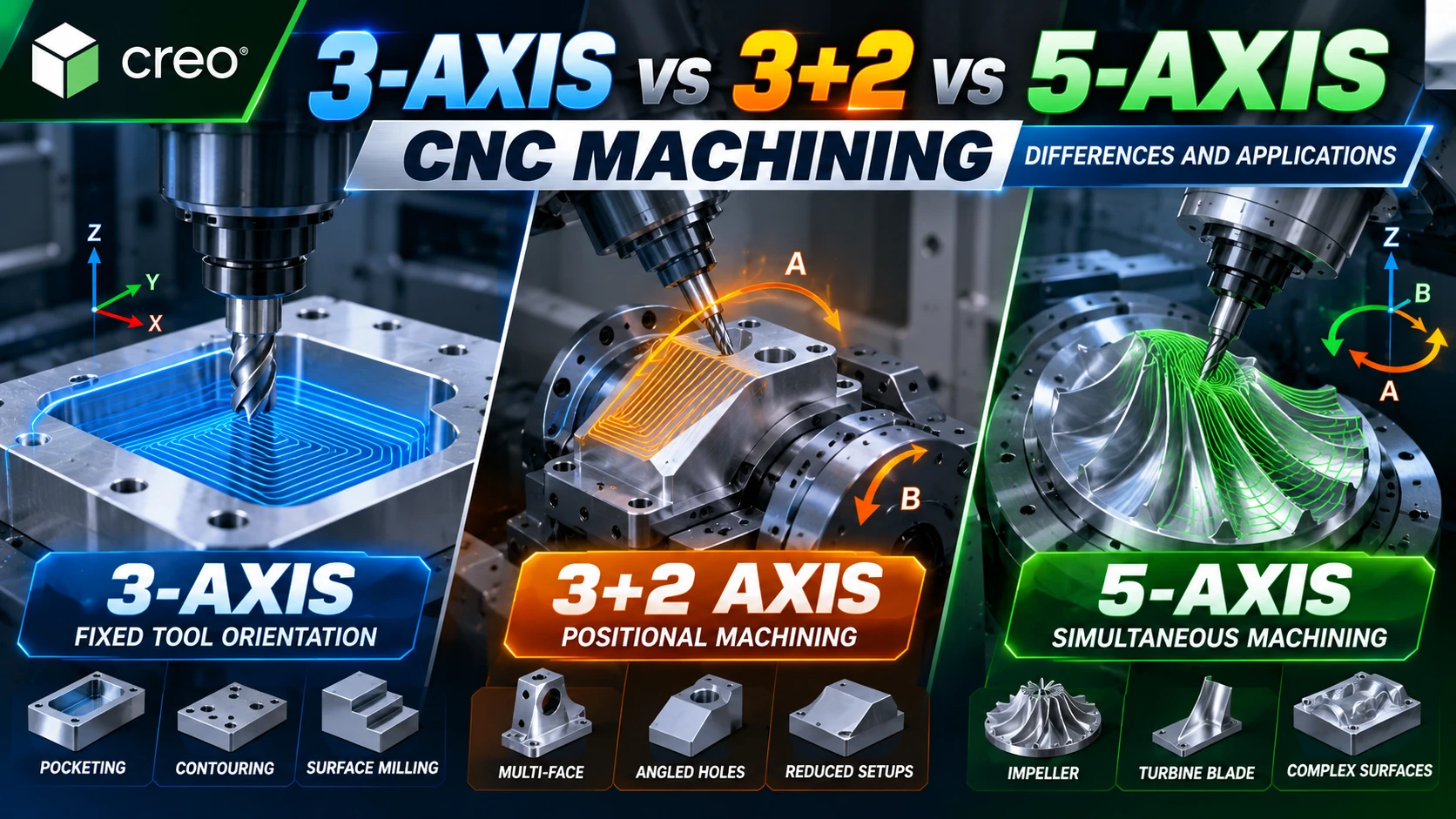
How are 3-axis, 3+2 and 5-axis CAM different? The main differences involve how the cutting tool approaches the part, whether the tool orientation remains fixed during cutting, how rotary axes are used and the complexity of the geometry that can be efficiently machined.
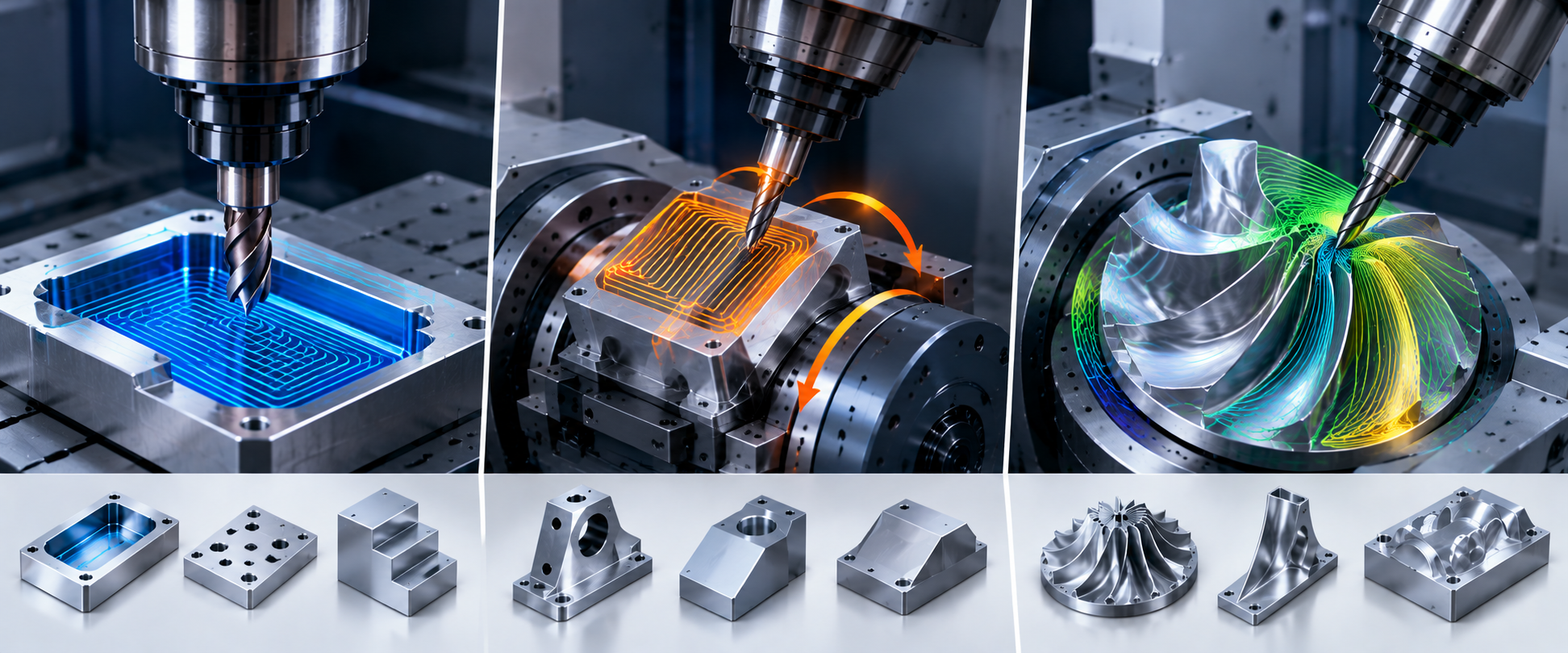
In 3-axis machining, cutting motion is primarily generated along the X, Y and Z linear axes with a fixed tool-axis orientation for a machining operation. In 3+2 machining, rotary axes position the tool or workpiece at a new orientation before a 3-axis toolpath is executed. In simultaneous 5-axis machining, linear and rotary axes can move together during cutting to control both cutter position and tool orientation.
Understanding 3-axis vs 3+2 vs 5-axis CAM helps manufacturers select an appropriate machining strategy according to part geometry, CNC machine configuration, surface requirements and production objectives.
PTC Creo CAM supports manufacturing workflows ranging from conventional CNC milling to advanced multi-axis machining depending on the deployed Creo manufacturing solution.
What Is 3-Axis CAM?
3-axis CAM generates machining toolpaths using three linear axes: X, Y and Z. During a machining orientation, the cutting-tool axis generally remains fixed while the cutter moves relative to the workpiece.
Three-axis machining is widely used for plates, housings, pockets, cavities, mold surfaces, fixtures and mechanical components that can be effectively accessed from a fixed machining direction.
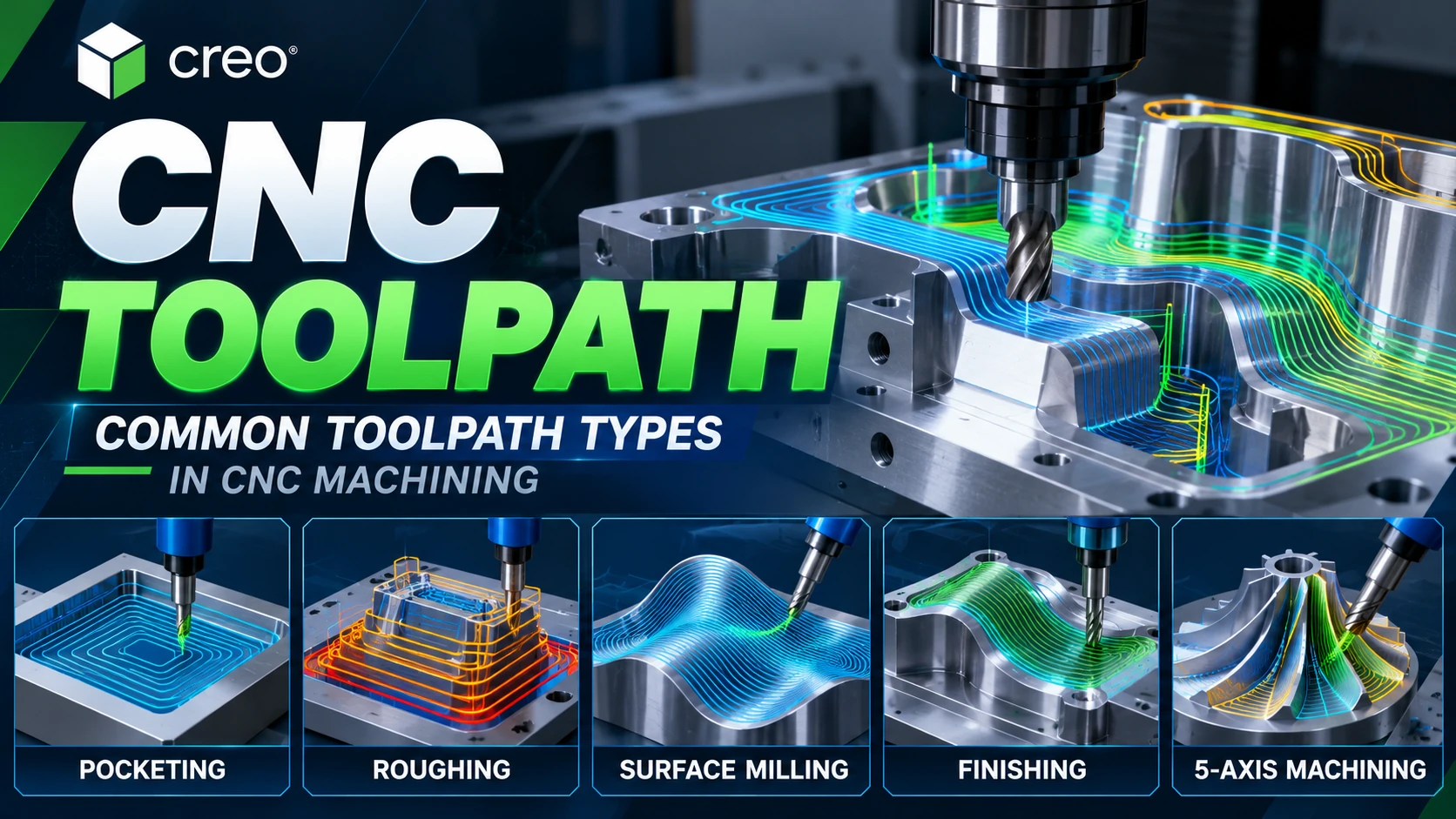
Common strategies include Face Milling, Roughing, Pocketing, Profile Milling, Surface Milling and Finishing. For additional background, see What Is a Toolpath? Common Toolpath Types in CNC Machining.
What Is 3+2-Axis CAM?
3+2-axis machining, also known as positional or indexed machining, uses the machine’s rotary axes to establish a machining orientation before executing a 3-axis toolpath at that orientation.
The “3+2” designation does not mean that all five axes continuously move together while material is being cut. The two additional rotary axes are primarily used to position the tool or workpiece, after which the cutting operation is performed using a fixed orientation.
PTC refers to this approach as 3+2 Axis or positional machining. In applicable Creo HSM Rough workflows, a 3-axis milling toolpath can be generated using different machining orientations to improve access to remaining material.
What Is 5-Axis CAM?
5-axis CAM is used to program CNC machines that combine three linear axes with two rotary axes. In simultaneous 5-axis machining, multiple axes can move together during cutting, enabling the CAM system to control both cutter position and tool-axis orientation along the toolpath.
This is the key distinction from 3+2 machining. In 3+2, an orientation is established before a 3-axis cutting operation. In simultaneous 5-axis machining, tool orientation can continuously change while the cutter moves across the part.
 3-Axis vs 3+2 vs 5-Axis CAM
| Factor | 3-Axis | 3+2 Axis | Simultaneous 5-Axis |
|---|---|---|---|
| Primary Motion | X, Y, Z | X, Y, Z plus rotary positioning | Linear and rotary axes coordinated |
| Tool Orientation During Cutting | Generally fixed | Fixed for each indexed orientation | Can continuously change |
| Toolpath | 3-axis | 3-axis at multiple orientations | Simultaneous multi-axis |
| Accessibility | Limited by fixed orientation | Improved access from multiple angles | Highly flexible for complex geometry |
| Programming Complexity | Generally lower | Higher than 3-axis | Requires advanced multi-axis control |
| Typical Applications | Pockets, housings, molds | Multiple faces, angled features | Impellers, blades, aerospace and complex surfaces |
What Is the Difference Between 3+2 and Simultaneous 5-Axis Machining?
Both methods can use a CNC machine with five controlled axes, but they use those axes differently during machining.
3+2 Axis: Position First, Then Machine
In 3+2 machining, the rotary axes orient the tool or workpiece to the required angle. The cutting operation is then executed as a 3-axis toolpath at that orientation.
Simultaneous 5-Axis: Orientation Changes During Cutting
In simultaneous 5-axis machining, rotary-axis motion can be coordinated with linear-axis motion while the cutter is engaged in machining. This enables tool orientation to adapt along complex geometry according to the programmed strategy.
PTC’s Creo HSM technology supports both 3+2-axis and simultaneous 5-axis toolpath workflows. Learn more from the official PTC High-Speed Milling overview.
Advantages of 3-Axis CAM
Three-axis machining remains important because many parts do not require multi-axis motion. When geometry can be efficiently accessed from a fixed direction, a 3-axis workflow can provide an effective combination of programming simplicity and machining capability.
- Relatively straightforward programming and setup.
- Compatible with a broad range of CNC machines.
- Effective for pockets, housings, plates and many mold surfaces.
- Less complex machine kinematics than multi-axis machining.
- Suitable for many roughing and finishing operations.
Advantages of 3+2-Axis Machining
3+2 machining bridges the gap between conventional 3-axis machining and simultaneous 5-axis programming by using multi-axis positioning while retaining 3-axis cutting at each orientation.
- Access multiple part faces in one setup.
- Reduce manual re-fixturing in appropriate applications.
- Machine angled holes and surfaces more directly.
- Potentially use shorter cutters at favorable orientations.
- Lower programming complexity than simultaneous 5-axis in many cases.
Advantages of Simultaneous 5-Axis CAM
Simultaneous 5-axis machining is valuable when the cutter needs to continuously change orientation to maintain access or a desired relationship with complex part geometry.
Typical applications include impellers, blisks, turbine blades, aerospace components, ports, undercuts, complex molds and freeform surfaces.
The additional motion also increases the importance of tool-axis control, collision checking, machine simulation and a correctly configured Post Processor.
3-Axis or 5-Axis for Mold Machining?
Not every mold requires 5-axis machining. Many cores, cavities and mold surfaces can be efficiently rough-machined and finished with 3-axis toolpaths when cutter accessibility is sufficient.
3+2 or simultaneous 5-axis machining becomes particularly useful for deep cavities, angled walls, undercuts and regions where a fixed tool orientation creates holder-clearance or accessibility problems.
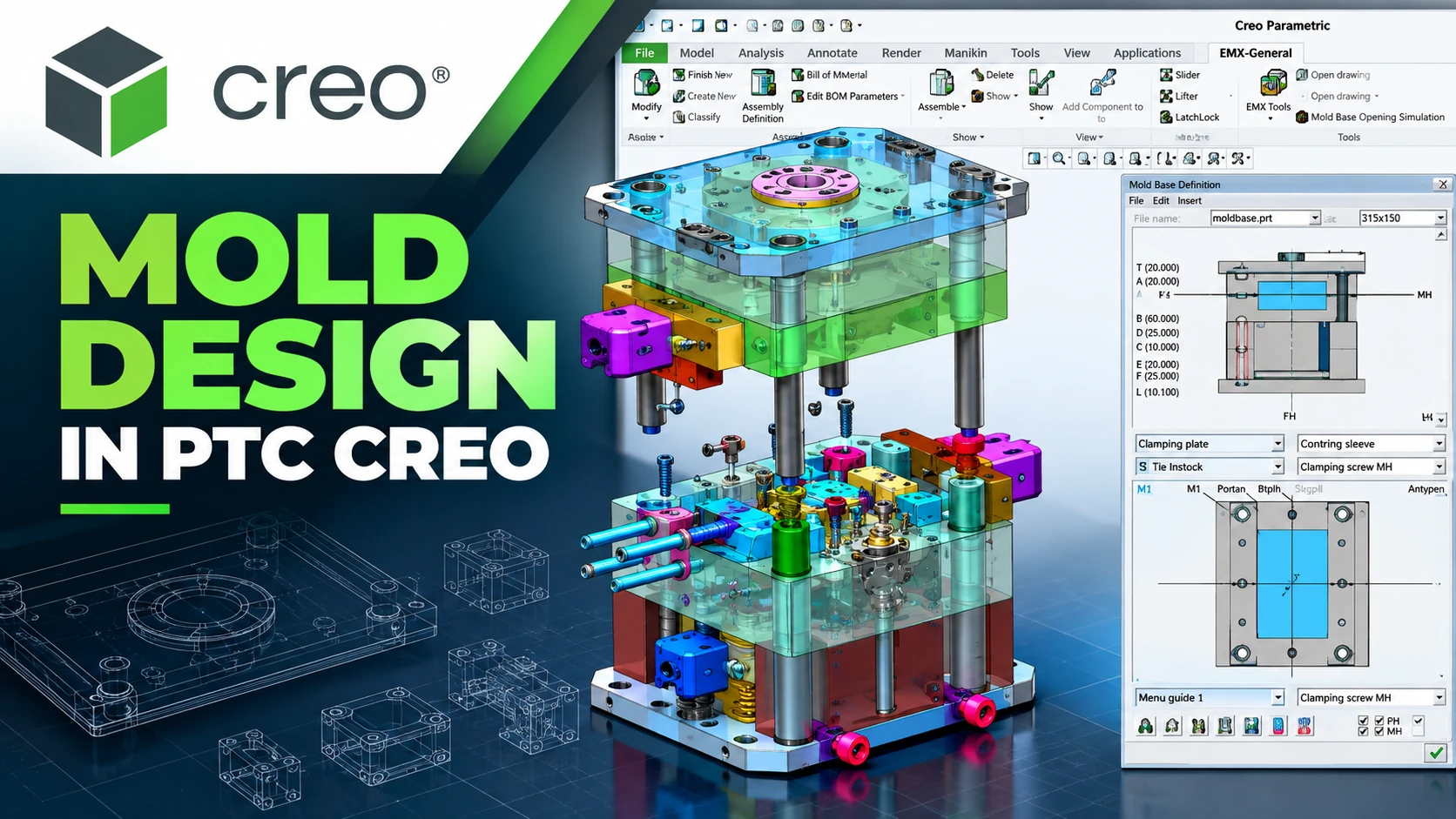
Mold manufacturers can combine Creo Mold Design with Creo CAM to connect tooling geometry with downstream CNC programming.
How Does the Toolpath Change from 3-Axis to 5-Axis?
In a 3-axis toolpath, CAM primarily calculates cutter position in X, Y and Z while maintaining a defined tool-axis orientation. Multi-axis programming adds the requirement to calculate cutter orientation according to geometry and tool-axis control rules.
This introduces additional considerations such as Lead Angle, Tilt Angle, Tool Axis Direction, Collision Avoidance, Holder Clearance, Machine Limits and rotary-axis motion.
Why Is Machine Simulation Important for 5-Axis CAM?
In multi-axis machining, avoiding a cutter gouge on the part is only one part of verification. Rotary-axis motion can also bring the holder, spindle, fixture and machine components close to each other as the machining orientation changes.
Machine simulation is therefore important for evaluating the complete kinematic motion and identifying potential collisions or axis-limit issues before an NC program reaches the physical CNC machine.
Why Is the Post Processor Important in 5-Axis Machining?
A Post Processor converts CAM toolpath data into an NC program appropriate for a specific CNC machine configuration and controller. For multi-axis machining, it must correctly account for the kinematics and rotary-axis behavior of the target machine.
Two 5-axis machines can have different head, table or head-table configurations, so machine-specific post-processing and validation remain important parts of a reliable manufacturing workflow.
Should You Use 3-Axis, 3+2 or 5-Axis CAM?
The decision should be based on part geometry, machine capability, required setups, surface requirements, tooling, fixtures, production volume and programming capability rather than simply selecting the largest number of axes.
| Requirement | Approach to Consider |
|---|---|
| Plates, pockets and accessible housings | 3-axis |
| Multiple faces in one setup | 3+2 |
| Angled holes or features | 3+2 |
| Continuously changing tool orientation | Simultaneous 5-axis |
| Impellers and turbine blades | Simultaneous 5-axis is commonly used |
| Complex mold cavities | 3-axis, 3+2 or 5-axis depending on geometry |
Is 5-Axis Machining Always Faster Than 3-Axis?
No. More controlled axes do not automatically produce a shorter cycle time. For straightforward geometry that can be efficiently machined in 3-axis, simultaneous 5-axis programming may add unnecessary complexity without providing a proportional manufacturing benefit.
The value of multi-axis machining is primarily its ability to improve accessibility, reduce setups in suitable applications, control cutter orientation and machine geometry that is difficult to reach with a fixed tool axis.
3-Axis, 3+2 and 5-Axis Machining in PTC Creo CAM
PTC Creo CAM provides manufacturing solutions for different levels of CNC machining. Depending on the deployed package, Creo manufacturing capabilities can extend from conventional milling to 4-axis and 5-axis positioning and simultaneous machining.
Explore PTC Creo CAM for CNC programming for an integrated workflow covering CAD geometry, CAM setup, toolpath generation, simulation and post processing.
For technical information about positional machining, see the official PTC Creo documentation for 3-Axis and 3+2-Axis Roughing.
FAQ About 3-Axis, 3+2 and 5-Axis CAM
What is 3-axis CAM?
3-axis CAM generates machining toolpaths using the X, Y and Z linear axes while the tool-axis orientation generally remains fixed during a machining orientation.
What is 3+2-axis machining?
3+2-axis or positional machining uses two rotary axes to position the tool or workpiece before executing a 3-axis toolpath at the selected orientation.
Is 3+2 the same as simultaneous 5-axis machining?
No. In 3+2 machining, rotary axes establish an orientation before 3-axis cutting. In simultaneous 5-axis machining, tool orientation can change while the cutting operation is being performed.
What is simultaneous 5-axis machining?
Simultaneous 5-axis machining coordinates linear and rotary axes during cutting to control cutter position and orientation along complex geometry.
Is 5-axis always better than 3-axis?
No. The appropriate method depends on part geometry, machine configuration, tooling, setup requirements and production objectives. Many parts can be efficiently manufactured using 3-axis machining.
Does Creo CAM support 5-axis machining?
Yes. Advanced Creo CAM solutions support 5-axis positioning and simultaneous multi-axis machining depending on the package and capabilities deployed.
Can a 5-axis machine perform 3-axis machining?
In many machine configurations, a multi-axis CNC can perform 3-axis operations with its rotary axes held at an appropriate fixed orientation.
PTC Creo CAM Consulting
CADCAM SOFTWARE is a PTC Gold Partner in Vietnam supporting manufacturers with PTC Creo solutions for product design, mold development and CNC programming.
CADCAM SOFTWARE COMPANY LIMITED
Hanoi Office: No. 25, Alley 34, Giap Nhat Street, Thanh Xuan Ward, Hanoi, Vietnam
Ho Chi Minh City Office: R.1508, Tower A, Masteri Centre Point, N2 Street, Long Binh Ward, Ho Chi Minh City, Vietnam
Tel: 024 6673 7986
Hotline: 0907 658 000
Email: info@cadcamsoftware.vn
Website: https://cadcamsoftware.vn/en/